
Prefilled Syringes Market to reach USD 29.68 Billion by 2035 at 11.72% CAGR
Prefilled Syringes Market Size
Prefilled Syringes Market to Surge from USD 11.58 Billion in 2026 to USD 29.68 Billion by 2035- Biologics Pipeline Expansion, GLP-1 Receptor Agonist Surge
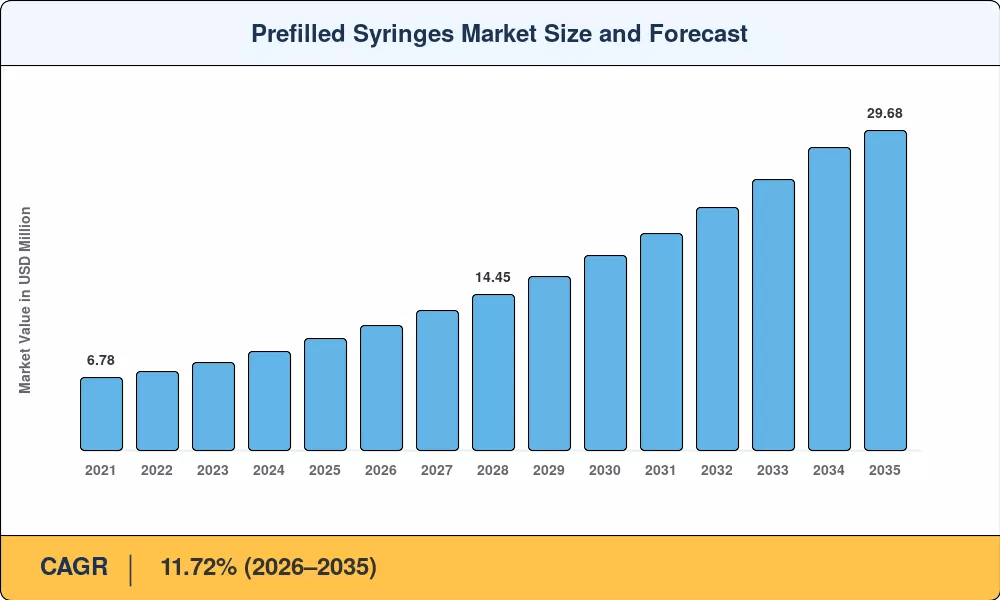
NY, CA, UNITED STATES, June 8, 2026 /EINPresswire.com/ -- As per Market Research Future, the global Prefilled Syringes Market size to reach USD 29.68 Billion by 2035 from USD 11.58 Billion in 2026, at a CAGR of 11.72% during the forecast period 2026--2035. The market base was estimated at USD 10.42 Billion in 2025.The 11.72% CAGR, nearly double the growth rate of the broader medical device sector-is driven by three converging structural forces: the global biologics pipeline now exceeding 8,200 active clinical-stage molecules requiring cold-chain-compatible single-dose drug delivery formats, tightening occupational safety mandates such as the EU Sharps Directive (2010/32/EU) compelling hospitals to adopt safety-engineered needle-based drug administration systems, and the generational shift from legacy vial-and-syringe workflows toward ready-to-use injectable devices that reduce overfill waste by 15--20% and cut bedside preparation time from minutes to seconds.
National governments and health systems are amplifying this momentum. Medicare Part B reimbursement reforms in the United States now favor physician-administered biologics in autoinjector pen systems, while the EU's Pharmaceutical Strategy for Europe accelerates biosimilar adoption. India's production-linked incentive scheme for medical devices has allocated INR 3,420 crore (approximately USD 410 million), with prefilled syringe fill-finish lines among eligible categories. China's National Medical Products Administration approved 12 biosimilar products in prefilled formats during 2024 alone. Together, these initiatives are creating the manufacturing infrastructure and regulatory pathways on which next-generation parenteral drug delivery depends.
Request A Free Sample: https://www.marketresearchfuture.com/sample_request/6167
Key Market Trends & Growth Drivers
Biologics Pipeline Expansion and Fill-Finish Capacity Surge
The global biologics pipeline-now exceeding 8,200 active clinical-stage molecules, with 62% of Phase III candidates being monoclonal antibodies and fusion proteins---is the single largest structural driver of the Prefilled Syringes Market through 2035. The FDA set a record in 2024 by approving 17 new biologics, and each approval increases the need for single-dose drug delivery systems across several years. Pharmaceutical companies are entering into five- to ten-year supply contracts with major packaging suppliers, establishing a structural demand floor for the prefilled syringe market through at least 2032.
Global investment in fill-finish capacity additions surpassed USD 4.8 billion in 2024 alone, with Schott, Gerresheimer, and Stevanato Group commissioning new high-speed lines across the U.S. and Southeast Asia. Early-adopter pharmaceutical manufacturers report that ready-to-use injectable devices reduce overfill waste by 15--20% and cut bedside preparation time from minutes to seconds when integrated into clinical workflows.
GLP-1 Receptor Agonist Surge and Autoinjector Pen Systems
Semaglutide and tirzepatide prescriptions exceeded 45 million annualized scripts in the U.S. by Q4 2024, a 67% year-over-year increase. Both drugs ship predominantly in autoinjector pen systems, and Novo Nordisk's Tyvyt facility in Clayton, NC---a USD 4.1 billion investment-will add 1.2 billion single-dose drug delivery units annually by 2027. This single therapeutic class now represents an estimated 12% of global prefilled syringe demand.
McKinsey estimates that the shift from vial-based to prefilled delivery for biologics could reduce per-administration costs by 40--60% when compared to outpatient infusion, making this the fastest-growing application segment at a 14.58% CAGR through 2035 for vaccines and 12.74% CAGR for home healthcare settings.
Needlestick Safety Mandates and Regulatory Reform
The EU Sharps Directive (2010/32/EU) and OSHA's Bloodborne Pathogens Standard collectively cover over 18 million healthcare workers across Europe and North America. Compliance requires adoption of safety-engineered needle-based drug administration devices with passive or semi-passive shielding mechanisms. Hospitals that fail audits face penalties up to EUR 500,000 per incident in Germany, creating non-discretionary demand for shielded prefilled formats.
In October 2025, BD collaborated with Ypsomed to combine Ypsomed's YpsoMate 2.25 autoinjector with the BD Neopak XtraFlow glass prefilled syringe, specifically addressing the requirements of newer GLP-1 therapies by focusing on the delivery of high-viscosity biologic medications (>15cP). In March 2026, Alkem Labs launched India's first Semaglutide single-shot prefilled syringe and pen formats, reflecting the regional shift toward domestic production of high-demand chronic care biologics.
Ask for Customization: https://www.marketresearchfuture.com/ask_for_customize/6167
Market Segment Insights
BY MATERIAL
Glass: Dominant segment with ~73% share in 2025. Supported by decades of regulatory precedent in borosilicate barrel manufacturing; every major pharmacopeia recognizes Type I borosilicate as a reference container material. Schott and Nippon Electric Glass control more than 70% of pharmaceutical-grade Type I borosilicate tubing production.
Polymer: Fastest-growing material at 11.84% CAGR (2026--2035). Cyclic-olefin polymer barrels challenge decades of borosilicate glass dominance, offering break-resistance, lower extractables, and compatibility with sensitive biologics prefilled packaging requirements. Daikyo Crystal Zenith and West Pharmaceutical's Daikyo-partnered COP platform are winning design-in awards from top-20 pharmaceutical companies.
Metal: Minor segment; primarily plunger and needle components integrated into combination products. Other Materials: Emerging silicone-oil-free barrels eliminating sub-visible protein aggregation, improving shelf-life by 15-25% for sensitive monoclonal antibodies.
BY APPLICATION
Diabetes: Dominant application with ~37% share in 2025. Reflecting the global insulin pen installed base exceeding 300 million units; insulin pens and GLP-1 autoinjector pen systems generating over 4.5 billion unit-doses annually.
Vaccines: Fastest-growing application at 14.58% CAGR. Propelled by pandemic-preparedness stockpiling and WHO prequalification of single-dose drug delivery formats. WHO's Immunization Agenda 2030 targets a 50% reduction in zero-dose children, requiring massive scale-up of prefilled vaccine formats across low- and middle-income countries.
Autoimmune Diseases: USD 1.87 Billion in 2025, driven by TNF-inhibitor and JAK-inhibitor self-injection pathways for rheumatoid arthritis.
Oncology: ~11% share; biologics prefilled packaging for supportive care and targeted therapies.
Hormonal Therapy: Growing segment for fertility and endocrine treatments in prefilled pen formats. Other Applications: Anticoagulants, emergency medications, and emerging therapeutic areas.
BY END USER
Hospitals & Clinics: Largest segment at ~44.8% share in 2025, driven by needlestick-injury compliance mandates and biologic infusion suites.
Pharmaceutical Companies: ~35% share; investing in companion fill-finish co-development and integrated combination product submissions.
Home Healthcare Settings: Fastest-growing end user at 12.74% CAGR, reflecting payer-driven site-of-care shift and decentralized healthcare delivery. At-home self-injection for at least one biologic category is currently reimbursed by payers in 28 OECD nations, up from 14 in 2019.
Ambulatory Surgical Centers: USD 1.15 Billion in 2025, with outpatient procedure growth driving demand. Research Laboratories: ~7% share; clinical trial supply and investigational biologics packaging.
Read Detailed Insights: https://www.marketresearchfuture.com/reports/prefilled-syringes-market-6167
Regional Outlook
North America -Dominant Market (~41% Share, 2025)
The United States generates approximately 82% of North American Prefilled Syringes Market revenue, driven by the largest installed base of biologic self-injection patients globally---an estimated 22 million Americans using prefilled autoinjectors for chronic conditions. CMS reimbursement changes under the Inflation Reduction Act are accelerating biosimilar adoption in the single-dose drug delivery format, while the FDA's 2024 guidance on combination-product cybersecurity is shaping connected-device specifications. Medicare Part B reimbursement reforms favor physician-administered biologics in autoinjector pen systems. Canada is growing at a steady pace on provincial formulary biologics coverage, contributing USD 0.38 Billion in 2025. Mexico is growing at 9.85% CAGR on COFEPRIS fast-track device registrations.
Europe -Second Largest (USD 3.02 Billion, 2025)
Europe's Prefilled Syringes Market benefits from the most prescriptive regulatory environment globally for needle-based drug administration safety. Germany leads regionally with ~24% of regional share, anchored by biosimilar substitution mandates and the Techniker Krankenkasse reporting a 34% increase in self-injection biologic prescriptions between 2022 and 2024. The UK is growing steadily anchored by NHS home-care biologics pathways, contributing USD 0.46 Billion in 2025. France is growing at 11.36% CAGR on ANSM safety-device requirements. Italy holds ~12% of regional share through chronic-disease prefilled pen programs. The Nordic countries are growing at 10.92% CAGR on high per-capita biologic spend. Spain contributes USD 0.27 Billion in 2025 on regional health service formulary expansion.
Asia-Pacific -Fastest-Growing Region (13.15% CAGR, 2026--2035)
Asia-Pacific is the highest-growth corridor in the Prefilled Syringes Market. China holds ~38% of regional share, with the National Medical Products Administration approving 12 biosimilar products in prefilled formats during 2024 and volume-based procurement of biologics accelerating the shift from vial-based workflows in tier-2 and tier-3 hospitals. India is growing at 14.62% CAGR on the back of the production-linked incentive scheme and a rapidly scaling medical-device manufacturing sector. Japan contributes USD 0.42 Billion (2025) through aging population and insulin demand. South Korea holds ~9% of regional share through biosimilar export-oriented manufacturing. ASEAN is growing at 13.48% CAGR on vaccine self-sufficiency programs. The region accounted for USD 1.37 Billion in 2025.
Middle East & Africa -Emerging Opportunity (10.48% CAGR, 2026--2035)
Saudi Arabia's Vision 2030 health transformation agenda holds ~28% of regional share, establishing domestic fill-finish capabilities for precision drug delivery. The UAE's Dubai healthcare corridor is growing at a solid pace, supported by medical tourism and specialty pharma, contributing USD 0.06 Billion in 2025. South Africa is growing at 11.25% CAGR on Aspen Pharmacare fill-finish expansion. Egypt holds ~12% of regional share through VACSERA local vaccine production. The African Union's Partnerships for African Vaccine Manufacturing targets 60% continental self-sufficiency in vaccine production by 2040, creating long-term demand for single-dose drug delivery infrastructure. Sub-Saharan Africa's cold-chain infrastructure gaps remain a restraint, with WHO estimating that 25% of vaccines reaching low-income countries experience at least one temperature excursion.
South America -Growing Presence (USD 0.52 Billion, 2025)
Brazil anchors South America's Prefilled Syringes Market at ~58% of regional revenue, with Fiocruz and Butantan Institute investing in prefilled vaccine packaging lines to reduce dependence on imported ready-to-use injectable devices, with combined capacity additions of 200 million units annually by 2028. Argentina's academic medical centers are emerging as regional hubs for biologics clinical trials, contributing USD 0.11 Billion in 2025 and growing at a healthy pace. The Pan-American Health Organization procurement programs further underpin regional market depth.
Competitive Landscape and Recent Developments
The Prefilled Syringes Market exhibits medium concentration, with the top five players capturing an estimated 52--58% of global revenue. The Herfindahl-Hirschman Index sits in the 1,200--1,500 range, reflecting a mix of vertically integrated glass suppliers, specialized device assemblers, and diversified medical-technology conglomerates. Competition is intensifying around polymer platform IP, connected-device capabilities, and integrated fill-finish service offerings.
The competitive landscape is stratified between large-platform integrators controlling end-to-end glass forming and device assembly workflows, mid-sized specialty firms focused on specific therapeutic areas, and polymer-native disruptors reshaping primary packaging economics.
KEY COMPANIES AND RECENT MILESTONES
BD (Becton, Dickinson) (October 2025): Collaborated with Ypsomed to combine Ypsomed's YpsoMate 2.25 autoinjector with the BD Neopak XtraFlow glass prefilled syringe, specifically addressing high-viscosity biologic medications (>15cP) for newer GLP-1 therapies. Estimated revenue share: ~14-18% of global Prefilled Syringes Market.
Gerresheimer AG (2024--2025): Commissioned new high-speed fill-finish lines across the U.S. and Southeast Asia as part of global capacity expansion surpassing USD 4.8 billion industry-wide. Gx RTF glass and COP barrels, MultiShell containers reinforce European leadership. Estimated revenue share: ~8-11%.
Schott AG (2024--2025): Expanded syriQ glass/polymer platform and iQ platform innovation. Type I glass tubing and finished syringe innovation with 18-24 month tank furnace commissioning lead times. Estimated revenue share: ~7-10%.
West Pharmaceutical Services (2024--2025): Daikyo Crystal Zenith COP platform winning design-in awards from top-20 pharmaceutical companies. Silicone-oil-free barrels eliminating sub-visible protein aggregation. Estimated revenue share: ~6-9%.
Stevanato Group (2024--2025): Commissioned new high-speed lines across Southeast Asia. EZ-fill nested tubs and Alba glass barrels with integrated glass-forming and assembly. Estimated revenue share: ~5-8%.
Alkem Labs (March 2026): Launched India's first Semaglutide single-shot prefilled syringe and pen formats in the Indian market, reflecting the regional shift toward domestic production of high-demand chronic care biologics.
Future Outlook: 2026--2035
By 2030, connected and smart prefilled devices are expected to represent a significant share of the Prefilled Syringes Market in leader countries, with embedded NFC tags and Bluetooth-enabled dose-tracking sensors converting prefilled syringes from passive containers into digital health endpoints. Payers in Germany and the U.S. are piloting adherence-linked reimbursement models, creating a data-monetization layer atop the physical device. Companies offering connected autoinjector pen systems with companion apps can command 10--15% price premiums over standard formats.
Wearable on-body injectors-essentially oversized autoinjector pen systems for high-concentration biologic formulations requiring 2-10 mL subcutaneous delivery-are emerging as the next-generation format, with Enable Injections, West Pharmaceutical, and BD all commercializing platforms by 2027. This segment could represent USD 3--4 billion in incremental Prefilled Syringes Market opportunity by 2034.
The next decade will see market consolidation around data-platform companies that aggregate manufacturing, clinical, and payer datasets at scale-creating recurring-revenue streams that mirror SaaS economics. AI-driven quality assurance in fill-finish operations, with machine-vision inspection systems achieving defect-detection rates above 99.7%, will become standard on 60% of new lines globally by 2030. WHO's Immunization Agenda 2030 and the African Union's Partnerships for African Vaccine Manufacturing underscore that health equity and commercial expansion are now aligned forces driving the Prefilled Syringes Market to its USD 29.68 Billion 2035 destination.
Browse More Related Research Insights:
https://www.marketresearchfuture.com/reports/injectable-drug-delivery-devices-market-1211
https://www.marketresearchfuture.com/reports/injection-pen-market-6146
https://www.marketresearchfuture.com/reports/biologics-market-1339
https://www.marketresearchfuture.com/reports/novel-vaccine-delivery-system-market-33752
https://www.marketresearchfuture.com/reports/drug-device-combination-market-6946
https://www.marketresearchfuture.com/reports/autoinjectors-market-6311
https://www.marketresearchfuture.com/reports/syringes-market-19219
https://www.marketresearchfuture.com/reports/insulin-delivery-devices-market-851
Larry Wilson
WantStats Research And Media Pvt. Ltd.
+1 855-661-4441
email us here
Visit us on social media:
LinkedIn
Facebook
YouTube
X
Legal Disclaimer:
EIN Presswire provides this news content "as is" without warranty of any kind. We do not accept any responsibility or liability for the accuracy, content, images, videos, licenses, completeness, legality, or reliability of the information contained in this article. If you have any complaints or copyright issues related to this article, kindly contact the author above.
