

Position Sensor Market to Reach USD 24.40 Billion by 2035 from USD 9.12 Billion in 2025
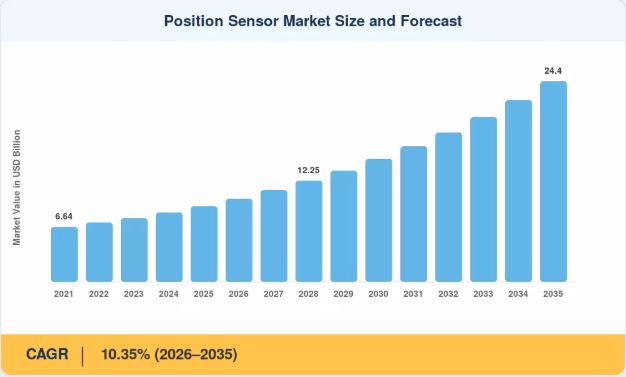
Position Sensor market
Position Sensor Market Size, Share and Research Report By Contact Type (Contact and Non-Contact), By Output (Analog and Digital)
Rising automation, EV adoption, and smart manufacturing are accelerating demand for high-precision position sensing technologies across industrial and automotive applications”
TOKYO, TOKYO, JAPAN, August 7, 2026 /EINPresswire.com/ -- The Global Position Sensor market reached an estimated USD 9.12 billion in 2025 and is projected to climb to USD 24.40 billion by 2035, expanding at a 10.35% CAGR during 2026–2035. Tightening safety mandates for autonomous agricultural equipment particularly the EU's revised Machinery Regulation (EU) 2023/1230 and USDA precision-agriculture incentive programs worth over USD 1.3 billion in cumulative grant allocations are compelling OEMs to embed higher-resolution displacement and angle feedback into every steering, hydraulic, and implement subsystem. — Market Research Future (MRFR)
The market's 10.35% CAGR reflects the convergence of autonomous tractor and sprayer mandates (~2.1% impact), MEMS miniaturization and cost reduction (~1.8%), digital bus protocol migration to CAN/SENT (~1.5%), and livestock health monitoring sensor roll-out (~1.2%) accelerating across the world's largest agricultural-mechanization economies simultaneously.
A decisive technology shift is underway as legacy potentiometric and resistive contact sensors give way to non-contact architectures built on Hall-effect, magnetoresistive, inductive, and optical principles. Semiconductor suppliers have shrunk MEMS sensing packages below 3 x 3 mm, slashing power budgets by 40% compared with 2020-era designs, a transition accelerated by over USD 780 million in combined R&D investment from the top-ten sensor OEMs between 2022 and 2024 targeting ruggedized modules that survive the dust, vibration, and wide temperature swings common in open-field and livestock operations.
Asia-Pacific dominates the market with a 48.8% revenue share in 2025, propelled by China's and India's large-scale mechanization drives and government subsidy programs, and the same region is also the fastest-growing, posting a projected CAGR of 11.90% through 2035. North America holds the second-largest share at 22.5%, underpinned by precision-agriculture adoption across the US Midwest and Canadian prairies. Convergence of edge-AI processing with energy-harvesting sensor nodes will reshape competitive dynamics over the coming decade.
Get Full PDF Sample Copy of Report: (Including Full TOC, List of Tables & Figures, Chart) @
https://www.marketresearchfuture.com/sample_request/2774
➤ How Significant Is the Position Sensor Market's Growth?
The position sensor market's trajectory from USD 9.12 billion in 2025 to a projected USD 24.40 billion by 2035 represents more than a two-and-a-half-fold expansion over the forecast decade, reflecting the structural shift from mechanical, wear-prone potentiometric designs toward non-contact, digitally networked sensing embedded across autonomous agricultural machinery. The market's 10.35% CAGR is anchored in a mechanization-and-regulation supercycle where EU safety mandates, USDA precision-agriculture grants, and falling MEMS costs are all converging to push position sensors from single-function components to safety-critical, fleet-connected data sources.
Linear sensors accounted for a 43.3% share of the market in 2025, driven by demand for stroke-position feedback in hydraulic cylinders and implement lift arms, while laser displacement sensors are advancing at the fastest pace among sensor types, with a projected CAGR of 14.18% through 2035, fueled by sub-micron accuracy requirements in indoor farming systems. Non-contact devices commanded a 65.5% share in 2025, reflecting the industry's migration away from wear-prone potentiometric sensors, and analog interfaces held a 61.3% share, though digital protocols such as CAN and SENT are climbing at a 13.20% CAGR as smart-farming platforms demand real-time bus integration. Agricultural vehicles and self-propelled machinery represent the largest application at 51.6% of 2025 revenue, though livestock position and health monitoring and indoor and vertical farming are each expanding at a 13.80% CAGR.
➤ What Does the Future Hold for the Position Sensor Market?
Autonomous tractor and sprayer mandates contribute approximately 2.1 percentage points to the position sensor market's CAGR the single highest driver impact. Category 3 safety-rated position feedback is mandated for all autonomous mobile machines sold within the EU single market under the Machinery Regulation (EU) 2023/1230, which takes effect in January 2027, with estimated compliance costs of EUR 1,200–2,500 per vehicle directly expanding addressable sensor content per unit. The USDA's AMS modernization grants, which exceeded USD 420 million in FY2024 alone, similarly encourage GPS-guided and sensor-integrated implements in U.S. row-crop operations.
MEMS miniaturization and cost reduction contribute approximately 1.8 percentage points to the CAGR, establishing semiconductor scale economics as a primary near-term demand source. Leading semiconductor houses have reduced MEMS inertial and magnetic sensor die area by 35% between 2021 and 2024, enabling package sizes below 3 x 3 x 0.9 mm and cutting per-unit sensor bill-of-materials costs by approximately USD 0.40, making non-contact alternatives economically viable for mid-tier tractors priced under USD 45,000 a segment representing 58% of global unit shipments. Digital bus protocol migration adds a further 1.5% to the CAGR as a 2024 Agricultural Electronics Foundation survey of 340 OEMs found that 67% plan to phase out legacy 0-5V analog outputs by 2028, creating a sensor replacement cycle worth an estimated USD 1.1 billion across North America and Western Europe.
The next product generation is shifting toward edge-AI and autonomous field operations, with on-sensor inference engines running lightweight neural networks enabling sub-millisecond position-correction loops for driverless tractors and robotic weeders. The global autonomous farm-equipment market is expected to surpass USD 70 billion by 2032, embedding 25 to 40 position sensors per autonomous platform. Battery-electric and hybrid-electric tractors entering series production starting in 2026 will replace hydraulic-valve position sensing with electric-actuator feedback loops requiring greater precision and electromagnetic-interference tolerance, with cumulative electric-tractor shipments expected to reach 320,000 units by 2033, each representing an increase in sensor content compared with conventional drivetrains.
Get access to the full description of the report @
https://www.marketresearchfuture.com/reports/position-sensor-market-2774
➤ Who Are the Key Players in the Position Sensor Market?
The position sensor market exhibits moderate concentration, with an estimated top-five combined share of 36–42% and a Herfindahl-Hirschman Index below 1,000. Competition is fragmented across global semiconductor houses, specialty sensor manufacturers, and regional distributors, each targeting distinct price-performance tiers. MRFR identifies the following key participants with estimated revenue share ranges:
★ TE Connectivity (~7–10% share) - a broad agricultural and industrial portfolio leader providing ruggedized linear and rotary LVDT sensors, having launched the KMXP series of magnetoresistive angle sensors rated to 150°C for next-generation autonomous tractor steering systems.
★ Honeywell International (~6–9% share) - an aerospace-grade reliability provider offering Hall-effect and magnetoresistive modules, transferring stringent aviation-derived quality standards into the harsh operating environments typical of agricultural machinery.
★ Renishaw plc (~5–7% share) - a premium accuracy specialist providing optical encoder and laser displacement systems, positioned for indoor-farming gantries and precision seed-placement applications requiring sub-10-micron measurement.
★ Balluff GmbH (~4–6% share) - a strong European OEM integration partner offering inductive and magnetostrictive linear sensors, having partnered with a leading Indian tractor OEM to co-develop IO-Link-connected position sensors for sub-50-HP tractors.
★ SICK AG (~3–5% share) - a machine-safety-certified product line provider offering laser and optical distance sensors, serving customers who require safety-rated position feedback for autonomous mobile machinery compliance.
★ Turck Inc. (~3–5% share) - a harsh-environment field application specialist providing inductive linear position sensors rated IP69K, engineered for dust, vibration, and wide temperature swings common in open-field operations.
★ Allegro MicroSystems (~3–5% share) - a fabless semiconductor scale leader offering Hall-effect and TMR ICs for angle sensing, having acquired a magnetic-sensor IP portfolio from a Swiss fabless start-up for USD 42 million to bolster its TMR angle-sensor roadmap.
★ ams-OSRAM AG (~2–4% share) - an ultra-low-power MEMS integration specialist providing magnetic rotary encoder ICs, targeting battery- and energy-harvesting-powered sensor nodes for remote pasture and orchard monitoring.
★ Pepperl+Fuchs (~2–4% share) - a process-automation crossover expert offering inductive and ultrasonic position sensors, leveraging its broader industrial-automation heritage to serve agricultural OEM customers.
★ ifm electronic (~2–3% share) - a digital-ready smart-sensor ecosystem provider offering IO-Link-enabled position sensors, positioned to serve smart-farming platforms that demand real-time bus integration and diagnostic data.
Strategic competition in the position sensor market is increasingly defined by non-contact, non-magnetic sensing alternatives that reduce rare-earth exposure with China's control of roughly 60% of global rare-earth refining capacity cited as a persistent supply-chain risk, as export-quota adjustments in 2023–2024 elevated NdFeB magnet prices by 18–22% and compressed sensor OEM gross margins by an estimated 120–150 basis points, alongside temperature-drift calibration burdens, rural connectivity gaps limiting digital-bus adoption, and fragmented regional safety certification requirements.
➤ What Are the Emerging Trends in the Position Sensor Market?
Several transformational trends are redefining the position sensor market's evolution through 2035:
Autonomous Equipment Safety Mandates: The EU Machinery Regulation (EU) 2023/1230 mandates performance-level-d position feedback on autonomous agricultural vehicles from January 2027, while USDA AMS modernization grants exceeding USD 420 million in FY2024 alone are encouraging GPS-guided and sensor-integrated implements across U.S. row-crop operations.
MEMS Miniaturization and Power-Budget Compression: Semiconductor houses have shrunk MEMS sensing packages below 3 x 3 mm and cut power budgets by 40% compared with 2020-era designs, making non-contact alternatives economically viable for mid-tier tractors priced under USD 45,000, a segment representing 58% of global unit shipments.
Digital Protocol Migration: Fleet-management platforms increasingly require real-time implement-position telemetry over CAN FD or SENT interfaces, with 67% of surveyed OEMs planning to phase out legacy 0–5V analog outputs by 2028, creating a sensor replacement cycle worth an estimated USD 1.1 billion across North America and Western Europe.
Indoor and Vertical Farming Sensor Content: Controlled-environment agriculture is projected to attract over USD 12 billion in cumulative capital investment by 2030, with each vertical-farm rack system requiring 8–14 linear position sensors for tray-elevator, nutrient-dosing, and LED-gantry control, insulating this segment from weather-driven demand variability.
Sensor-as-a-Service and Data Monetization: Equipment OEMs are exploring subscription-based fleet-analytics platforms where position-sensor data feeds predictive-maintenance algorithms, with pilot programs at two major North American implement manufacturers reportedly yielding 22% higher customer lifetime value.
Buy Full Research Report:
https://www.marketresearchfuture.com/checkout?currency=one_user-USD&report_id=2774
➤ How Is the Position Sensor Market Segmented?
The position sensor market report provides a comprehensive segmentation framework:
By Type: Linear Sensors (43.3% share, 2025), Rotary Sensors (38.2% share, 2025), Laser Displacement Sensors (14.18% CAGR), Other Sensor Types (4.5% share, 2025)
By Technology: Non-Contact (65.5% share, 2025), Contact (34.5% share, 2025)
By Output Interface: Analog (61.3% share, 2025), Digital / CAN / SENT (13.20% CAGR)
By Application: Agricultural Vehicles / Self-Propelled Machinery (51.6% share, 2025), Livestock Position and Health Monitoring (13.80% CAGR), Indoor and Vertical Farming (13.80% CAGR), Other Applications (8.9% share, 2025)
By Region: Asia-Pacific (48.8%), North America (22.5%), Europe (19.2%), South America (5.3%), Middle East & Africa (4.2%)
➤ What Are the Regional Insights from the Position Sensor Market?
Asia-Pacific dominates the position sensor market with a 48.8% revenue share in 2025 and the fastest regional CAGR at 11.90%, with China commanding 42% of regional revenue through state-subsidized smart-agriculture pilots backed by over CNY 15 billion allocated annually toward agricultural-machinery purchase subsidies. India is posting a 13.1% CAGR within the region through its Sub-Mission on Agricultural Mechanization, which continues to fund sensor-integrated implements for marginal and smallholder farms, Japan contributes USD 0.52 billion through robotic rice-transplanter adoption, South Korea holds 8% of regional share through vertical-farming and greenhouse technology, and ASEAN is growing at an 11.5% CAGR through palm-oil and rubber plantation automation.
North America holds approximately 22.5% of global position sensor market share, with the United States commanding 78% of regional revenue as the Midwest and Great Plains account for the vast majority of demand, where combine harvesters and self-propelled sprayers increasingly ship with 12–18 position sensors per machine. USDA Conservation Reserve Program payments and Inflation Reduction Act provisions for climate-smart equipment have provided additional procurement incentives. Canada is growing at a 10.8% CAGR through Prairie grain-farming modernization, and Mexico contributes USD 0.11 billion through protected-agriculture greenhouse expansion.
Europe accounts for approximately 19.2% of global position sensor market share, with Germany commanding 28% of regional revenue as home to major implement and tractor OEM headquarters including CLAAS, Fendt, and Lemken, whose sensor-specification trends propagate across global product platforms. The UK is growing at a 10.2% CAGR through post-Brexit ELMS farm-technology grants, France contributes USD 0.29 billion through vineyard and cereal-crop automation, Italy holds 12% of regional share through olive and fruit orchard mechanization, Spain is posting a 9.8% CAGR through greenhouse horticulture sensor adoption, and the Nordic countries contribute USD 0.12 billion through dairy-barn robotic systems, with EU Common Agricultural Policy eco-scheme payments indirectly driving demand for calibrated position feedback on variable-rate applicators.
South America and the Middle East & Africa together represent a smaller but strategically important share of the position sensor market. Brazil commands 72% of South American revenue, driven by soybean and sugarcane harvester fleets, with the BNDES-financed Moderfrota program providing low-interest credit for agricultural machinery purchases and expanding the installed sensor base by an estimated 15,000 units per year, while Argentina is growing at a 10.6% CAGR through Pampas-region precision-agriculture adoption. In the Middle East & Africa, Saudi Arabia commands 31% of regional share through Vision 2030 agri-tech investment channeled via its National Agriculture Development Company, the UAE is growing at a 12.4% CAGR through controlled-environment farming in desert climates backed by Abu Dhabi's ADQ sovereign fund, and Egypt holds 18% of regional share through Nile Delta irrigation automation.
➤➤➤ Industry Analysis Reports by Market Research Future:
Magnetic Proximity Sensors Market
https://www.marketresearchfuture.com/reports/magnetic-proximity-sensors-market-42812
High End Imu Market
https://www.marketresearchfuture.com/reports/high-end-imu-market-42817
Sensor Fusion In Autonomous Vehicle Market
https://www.marketresearchfuture.com/reports/sensor-fusion-in-autonomous-vehicle-market-42848
Inductors Cores And Bead Market
https://www.marketresearchfuture.com/reports/inductors-cores-and-bead-market-42849
Medium Voltage Electric Drives Market
https://www.marketresearchfuture.com/reports/medium-voltage-electric-drives-market-42861
Binder Jetting 3D Printing Technology Market
https://www.marketresearchfuture.com/reports/binder-jetting-3d-printing-technology-market-42869
Ultra Large Scale Ic Market
https://www.marketresearchfuture.com/reports/ultra-large-scale-ic-market-42877
Thermography Condition Monitoring Equipment Market
https://www.marketresearchfuture.com/reports/thermography-condition-monitoring-equipment-market-42882
Semiconductor Applications In Healthcare Market
https://www.marketresearchfuture.com/reports/semiconductor-applications-in-healthcare-market-42885
It Connector Market
https://www.marketresearchfuture.com/reports/it-connector-market-42892
Sagar Kadam
Market Research Future
+ +1 628-258-0071
email us here
Legal Disclaimer:
EIN Presswire provides this news content "as is" without warranty of any kind. We do not accept any responsibility or liability for the accuracy, content, images, videos, licenses, completeness, legality, or reliability of the information contained in this article. If you have any complaints or copyright issues related to this article, kindly contact the author above.
